

UP Geology ’77: Third Biggest Batch of UP Geologist
Martial
Law Babies
For
those who completed BS Geology in the usual 4-5 years term,
freshman year started during the beginning of the martial law
regime of Marcos – 1972-73. The years of student activitism,
rallies and marijuana culture were becoming things of the past
and the orderliness and predictability of the “New Society”
were more or less in place. Although there were still a few
“rebels” among us, it was all hidden and anti-establishment
ideas were spoken only in whispers. Long hair, cigarettes, bell-bottoms,
maong and mini-skirts were in fashion – a fashion that has been
copied albeit modified in the late nineties.
Tremendous
Change
1972-73
were years of tremendous change for many of us, a transition
from a tumultuous high school era of hippie and flower power
to the open spaces of a stymied but relaxing UP Diliman campus.
First impression of UP Diliman is the vastness of the university
grounds with lots of trees and a lot of walking between buildings.
Second impression was the large number of students from all
walks of life – boys and girls (there were very few in betweens
during that time). Various social backgrounds were represented
– from exclusive schools in Metro Manila to provincial public
schools. But unlike today, very few students drive their own
car in the campus. Almost everybody rode on the “ikot”
jeepneys or walked and walked and walked. Also, there was an
unspoken rule on “pila” (falling in line) for anything
you do in UP – eating, getting IDs, waiting for the jeepneys,
physical checkup, etc. In fact, it was a common joke that UP
stands for University of Pila.
Geology was taught then at the Department of Geology located at the second floor, 3rd Pavilion of the College of Arts and Sciences, a dark alley even during daytime. The Department then was not equipped to have a big student population. The 1970-76 batches before us had only 3 to 16 graduates, most of them taking more than the required 4 years. Our batch had 47 graduates, third biggest batch since the founding of the Department in 1957! And that was just the start. The succeeding batches, 1978 to 1980, had 28 to 35 graduates each. The main reason for the sudden increase of geology students at that time was the start of the geology scholarship programs of the Bureau of Mines. The first scholars of the Bureau of Mines scholars were in our batch – there were 14 of us. There were also a few scholars sponsored by some mining and oil companies.
Although it was encouraging that geology was becoming attractive to the studentry, this trend had its downsides. One of them was the teacher to student ratio increased too rapidly. Our professors could hardly cope up with the number of students. There were only 6 full-time professors and 2-3 laboratory assistants. Most had a hard time remembering our names unlike the previous batches. Only the best and the worst students caught their attention. Another downside was the existing laboratory equipment and teaching materials were no longer adequate for the students. Microscopes, which are important, had to be shared among 2-3 student unlike before where each student had access to one each?
Until recently, geology was a male-dominated profession. The subtle change happened during our time. Female geologists started creeping in. In our batch, we had a total of 7 – the highest number during that time. Today, the opposite is the norm – there are more female than male geologists.
Freshman
to Sophomore Years
During the freshman year, the only geology subjects offered
were Principles of Geology and related laboratory work (Geo.
11 and 11.1). Geology 11 was an eye opener for geology but stressful
as it was Dr. Emmanuel Tamesis who taught it. Tammy, as he is
fondly called, was the best teacher in our school during our
days but was considered a “terror”. Everybody knew
that everyone would be called to answer a question. So everybody
held their breath until they are finally called for recitation.
Come to think of it, Geo. 11 was probably the hardest subject
as it was like taking a crash course in geology in one semester.
Very few got a grade better than 2.00 from Tammy. Although it
felt like heaven-sent at that time, it was a pity that Tammy
became too involved with the petroleum industry that he had
to take leave from the Department. We only appreciated him several
years after our graduation.
In the sophomore years, the geology subjects taken were Historical Geology (Geo. 20) and Mineralogy (Geo. 40). There were a few Chemistry majors in Geo. 40 since it was a pre-requisite in their department. Boy, were they bored to death with this subject. Somehow, they could not fathom how mineralogy with all those wooden crystal figures that they keep on imagining the axes, forms and faces could have anything to do with chemical formulas. Well, neither did we. By that time, we began to know more of our Department and our geology colleagues. Slowly but surely, we began to unconsciously “evolve” to a different person – a geologist.
Explosion
of Student Organizations
Life as a geology major really started in our junior year.
Subjects taken were mostly about geology. These were Petrology,
Optical Mineralogy, Paleontology, Stratigraphy, Geochemistry,
Petrography and Structural Geology. That was year 1975. That
was also the time of the sudden explosion in the number of student
organizations in the Department. Besides the Geological Society
(GeoSoc) and the Association of Filipino Amateur Geologists
(AFAG), two other organizations sprung up. They were the Iuvenis
Orbis Geological Fraternity (IOGF) and Geology Major Society
(GEMS). One thing for sure, the Department had more than enough
venues for practicing leadership skills in our batch.
Summer
Field Geology
The happiest and well-remembered part of our stay in UP
is the summer field geology practice after our junior year.
At that time, the Department did not conduct this course unlike
today. We, through application and endorsement by the Department,
were taken in as trainees by the mining and oil companies for
a period of 2 months. Most companies took 1 to 5 trainees per
year. Although we considered the training track record and possibility
of immediate employment after graduation in established companies,
they were not the only criteria. The other major criterion was
how much cash allowance was given. The companies that paid most
were the exploration companies and not the established mining
companies, as it was common for the former companies to employ
students for summer to do their routine work. For most of us,
it was the first time that one finally earns a living. Although
the pay was not big, it was mind boggling enough for us. Some
received up to 30 pesos per day. Yes, that was big money during
that time. Not only we have cash allowances, all amenities were
provided for – meals, lodging, traveling, etc. We felt like
royalty for 2 months except to those who had to do “manual
labor” in the mining companies. But one had to say that
they were trained well, Kudos to the likes of Philex, Lepanto
and Benguet Corporation. Of course, the best part of the summer
training was that we were outside the control of the Department
and our parents/guardians. It felt like real independence. It
was the first flapping of wings of an eaglet before the momentous
dive into the real world. We found new friends, including those
of the other sex. Well, that is another chapter to tell.
Senior
Year
Our senior year was anti-climatic. It was more of going
through the motions. The only remaining geology subjects to
complete were Geophysics, Petroleum Geology, Mineral Economics,
Sedimentation, and Ore Deposits. Some had to complete or repeat
non-geology subjects they dropped or failed previously like
guess what …. Chemistry, Physics and Spanish. Some made it
to the last minute by cramming the last subjects in the summer
of 1977 including repeating field geology. Even with all these
problems of a senior student, we were happily surprised that
most of us were already being offered jobs even before graduation!
We had the luxury of choosing which one we like … except
the scholars. Well, that is how the cookie crumbles, isn’t
it? Sometimes you win, sometimes you lose.
Our
Mentors
Lastly, reminiscing our time in the Department will not
be complete without mentioning our mentors. We would like to
thank the professors and instructors who taught us the rudiments
of our profession – Mrs. Milagros Reyes, Mrs. Visitacion Gervasio,
Dr. Priscilla Matias, the late Dr. Fernando Gutierrez, Dr. Ernesto
Sonido, Dr. Raymundo Punongbayan, Dr. Benjamin Austria and the
late Mr. Eliseo Kintanar.
We are very fortunate that we still managed to be in the last classes of Dr. Emmanuel Tamesis who, by the way, returned to teaching in the late 70’s to late 90’s. Special mention is given to the late Mr. Eliseo Kintanar, who was also an inspiration. Even without a PhD to boast of, he made Petroleum Geology a piece of cake. He hammered us on common sense and practicals of basin analysis.
By
Ciceron A. Angeles, Jr.
BS Geo ‘77
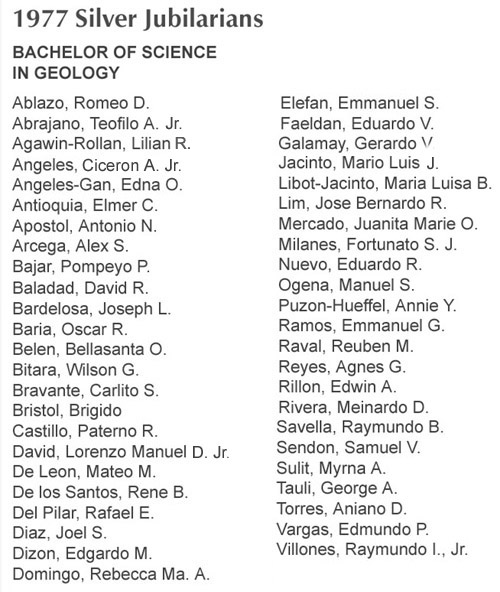
1977 Silver Jubilarians
 |